Category Archives: 1-Year Bible

February 4


Exodus 19:16-21:21

God was about to do something so amazing. He was about to reveal His Word to-and-through his mediator Moses in order to communicate the civil law to Israel who would be established as a nation ruled by God. This theocracy was unique for them among all the nations of the world.

So the LORD “descended” in the thunder, and lightning, and cloud, and smoke, and sound of a trumpet. It was all intended to plant a healthy fear into the hearts of the people…and it worked for the moment (Exodus 20:18-21).

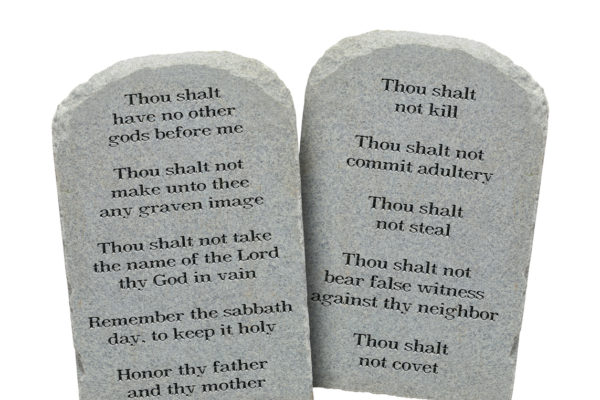
But – before God established the civil law, He revealed the moral law, the 10 Commandments. The first 4 commandments deal with our relationship with God (vertical), while the final 6 commandments have to do with our relationship with others (horizontal). 

The 10 Commandments are godly goals to strive for as a society. What harmony we would have if only we held to them, and we should never cease in our attempt to keep them – but – they were also given to show us we’re sinners, due to the fact that no one can keep the 10 Commandments perfectly. Keep in mind Jesus’ words – that it’s not simply the act on the outside God considers, it’s also the thoughts on the inside (Matthew 5:21-28).

You’ll notice as we read through the Bible that 9 of the 10 Commandments are repeated in the New Testament explicitly, so the moral law (unlike the civil and ceremonial law) still stands. The only commandment NOT repeated in the New Testament specifically, is the Sabbath Day. Regarding the Sabbath, the Bible says we are not to judge others on this issue (Colossians 2:16), and although it’s a wise principal and good for us in every way, it’s not mandated. If someone does choose to keep 1 day out of the week as a Sabbath, that person has the option of choosing which day works best for them (Romans 14:5).
Attachment.jpeg

The issue of slavery is brought up here in Exodus 21. I found the following quote from “Got Questions” to be helpful.

Exodus 21:1-6 reveals the laws of a bondservant. This title of “bondservant,” is what many of the Apostles called themselves in relationship to Jesus Christ – willing servants, slaves, who have surrendered their rights to serve the LORD forever. It’s all rooted in love. We read in:

Exodus 21:5 (NKJV) “But if the servant plainly says, ‘I love my master, my wife, and my children; I will not go out free,’”

May this be the declaration of our hearts.

As we read through the laws given to Israel, we may consider some to be not just harsh, but wrong. Imagine facing the death penalty because you cursed your parents! Well, it is harsh, but it isn’t wrong. I’m not saying this should be a law for all nations today (context needs to be considered) but it is tragic to see the disrespect and dishonor many children have towards their parents today. Those parents are the symbol of authority, so when children have no conviction to honor and obey their parents, it spills over into all other forms of authority – teachers, police officers, government, and ultimately God.

Penalties described and applied are indeed preventative.


Matthew 23:13-29

Jesus indicts the Scribes and Pharisees vehemently. They were legalistic hypocrites who reproduced themselves with an evil that escalated. They devoured widows houses by taking their money (imagine that). They prayed long eloquent prayers, but only for show. They were fools who had it all wrong, backwards, they were blind leaders of the blind. They tithed from their gardens to God (there’s that legalism showing up) but neglected to keep the more important things, like justice, mercy, and faith. Jesus said, “You should have practiced the latter, without neglecting the former.” They were straining at gnats, but swallowing camels; they looked good, alive on the outside, but they were bad to the bone, dead on the inside (see Revelation 3:1).

These religious leaders who knew and had been given so much, with positions of great responsibility, would receive a greater condemnation, for one day, justice will be served (Luke 12:48; James 3:1).

As Jesus wept over Jerusalem we see not only His tears, love, and compassion, we also have provided for us a deep doctrinal truth. Did you notice the words “I wanted” and “you were not willing?” These simple statements teach us much about the doctrine of soteriology (salvation).

There are some in Christendom who say that ALL whom God chooses, or wants to be saved – will be saved. They also teach that ALL the others who God does not choose, have no chance to be saved. These are some of the tenets, teachings of Calvinism.

But here we see the contrary, we see that Jesus wanted the people to come to Him, but they were not willing. He therefore wept over their eventual judgment.

If we are open and wise and don’t isolate certain passages at the expense of others, we will discover that the Bible clearly teaches that God wants everyone to be saved, but they/we are free to choose whether or not we will come to Him (1 Timothy 2:4; 2 Peter 3:9).


Psalm 28:1-9

This is another beautiful Psalm, Song, and Prayer of David’s – a cry for God to answer and protect him from his enemies, death, and most likely King Saul.

David prays for God not to be silent, or passive, for God to rise up and answer his prayer.

There were people who wanted David to be done and dead. They sounded like friends, but in all reality they were foes. David described them as people, “Who speak peace to their neighbor, but evil is in their hearts.” (Psalm 28:3) Those are the most dangerous ones.

David prayed for God to “Render to them what they deserve.” (Psalm 28:4) It was David’s way of praying for protection and preservation.

We may not be David, the future king of Israel, but I do believe we have something special for our futures, especially if we’re serving and seeking God. The enemy will therefore come against us. We must pray – and obey.

I love the way David ends this Psalm as he does most Psalms, with declarations of faith – God WILL answer our prayers.

Psalm 28:6–7 (NKJV) “Blessed be the LORD, because He has heard the voice of my supplications! 7 The LORD is my strength and my shield; my heart trusted in Him, and I am helped; therefore my heart greatly rejoices, and with my song I will praise Him.”

In verses 8-9 David goes beyond himself and also prays for the people.

He will make a good king one day.


Proverbs 7:1-5

Proverbs 7:1-5 (NKJV) “My son, keep my words, and treasure my commands within you. 2 Keep my commands and live, and my law as the apple of your eye. 3 Bind them on your fingers; write them on the tablet of your heart. 4 Say to wisdom, “You are my sister,” and call understanding your nearest kin, 5 That they may keep you from the immoral woman, from the seductress who flatters with her words.

Keep, treasure, bind, write these words within you, on the tablet of your heart, let God’s law be the apple of your eye.

Go ahead and say it, speak it out loud, say to wisdom, “You are my sister…” value this understanding as you would kin, close family.

What for? Why should I do that? 

Part of the reason is that this is Proverbial protection from seduction – from the immoral man or woman who flatters with their words.

Not to freak you out, but I promise you, the devil, influences certain people in this world to come after you, to try and trip you out, and trap you in.

Let’s not consider ourselves to be beyond this temptation. Let’s value the wisdom of God and His Word so much, that we hold it in our hearts, live it in our lives, and enjoy God’s protection. He will give us victory of the beast, He will help us slay the giant.

If you have any questions or comments on today’s reading, or you’d like to share something the Lord showed you, feel free to leave a reply below. I’d love to hear from you as we grow forward in 2021.

February 3


Exodus 17:8-19:15

The nation of Amalek attacks Israel (Exodus 17:8) and Moses has an interesting battle plan. As Joshua and the men are sent out to fight, Moses would ascend to the top of the hill and lift his hands to God. We read the initial results:

Exodus 17:11 (NKJV) “And so it was, when Moses held up his hand, that Israel prevailed; and when he let down his hand, Amalek prevailed.”

Do you “get” the picture here? As Moses sought the LORD, as Moses looked to the Lord, reached up to Him, as he worshiped and prayed, the nation prevailed, symbolized in the lifting of his hands. But naturally he would tire in the process, so he had to let down his hands at times – and this is when Amalek prevailed over Israel. What to do? Aaron and Hur come alongside Moses, hold up his hands, and Israel wins.

Pastor Chuck Smith (and others) see this as the help a pastor needs in being a vessel of blessing and a weapon of victory for the people. Pastors are called to prayer and the ministry of the Word (Acts 6:4) so when other assistants come to their side and “hold up their hands” by taking care of the other responsibilities in the church, this allows the pastor-servant-leader to worship and pray and hear from God for the congregation…resulting in victory for the people.

We see a similar principle in Jethro’s question and eventual advice to Moses after seeing all the people going to Moses from morning till evening.

Exodus 18:14 (NKJV) “So when Moses’ father-in-law saw all that he did for the people, he said, ‘What is this thing that you are doing for the people? Why do you alone sit, and all the people stand before you from morning until evening?”

Moses let his father-in-law Jethro know that he was the counselor and guide for the people. Perhaps to some it sounded noble that Moses would make himself available for EVERYONE,  but anyone could see that this was an absolute impossibility. Moses would wear himself out and the needs of the people would NOT be met.

Jethro gives Moses excellent advice, I don’t think I can word or summarize it any better:

 Exodus 18:19–23 (NKJV) “Listen now to my voice; I will give you counsel, and God will be with you: Stand before God for the people, so that you may bring the difficulties to God. 20 And you shall teach them the statutes and the laws, and show them the way in which they must walk and the work they must do. 21 Moreover you shall select from all the people able men, such as fear God, men of truth, hating covetousness; and place such over them to be rulers of thousands, rulers of hundreds, rulers of fifties, and rulers of tens. 22 And let them judge the people at all times. Then it will be that every great matter they shall bring to you, but every small matter they themselves shall judge. So it will be easier for you, for they will bear the burden with you. 23 If you do this thing, and God so commands you, then you will be able to endure, and all this people will also go to their place in peace.”

The difficulties (great matters) were to be brought to Moses, but the other issues would be delegated to leaders who loved the Lord and had been taught God’s Word. Thank God Moses heeded Jethro’s advice!

It’s now been 3 months since Israel has been redeemed from Egypt and God is about to establish a covenant with them as His special people. God cared for and carried them to Himself and wanted them to be that special treasure above all people entering into a love relationship (that’s his heart behind the command to keep his covenant – see John 14:21).

And just in case someone sees this as God loving Israel at the expense of the rest of the world, notice their calling in Exodus 19:6, that they were called to be a kingdom of priests. Priest are in one sense, representatives of God, called to reach out to the rest of the world. God wanted to reach the world through Israel…if only they would have realized this role and responsibility in life!


Matthew 22:34-23:12

Tragically these lost religious leaders were ONLY attempting to trap Jesus in His words. 

What’s the greatest commandment? Love God – period – wholeheartedly. The second is similar, Jesus says, and I have to tell you because it’s closely connected to the first, love ALL others the way you love yourself.

All other 800 commandments in the New Testament are rooted in these 2 commandments. 

Let’s not complicate this, ‘cuz it all comes down to this – so simple. I search my heart. Do I love God? If I do, I’ll obey Him and I’ll definitely love others. John the Beloved wrote in:

1 John 4:20 (NKJV) “If someone says, ‘I love God,’ and hates his brother, he is a liar; for he who does not love his brother whom he has seen, how can he love God whom he has not seen?”

They say we love God as much as the person we love the least (ouch). Help us Lord.

Jesus then turns the tables on the religious leaders with a simple question. Whose son will the Messiah be? Their response was, “the son of David” – just  a descendant of David. But Jesus quotes from Psalm 110:1 and emphasizes the fact that David calls the Messiah “Lord.”  Obviously the Messiah is not merely the son of David, He’s more than that, He’s also the Son of God. But they refused to see, the closed their eyes and hardened their hearts. If only they would have been open to the written Word and Living Word right before them.

Jesus goes on to give general instruction to the people in that setting and a scathing rebuke to the religious leaders of the day:

Matthew 23:2–3 (NLT) “The teachers of religious law and the Pharisees are the official interpreters of the law of Moses. 3 So practice and obey whatever they tell you, but don’t follow their example. For they don’t practice what they teach.”

Jesus has tried the gentle approach for 3 years, to no avail; it’s now time to call them to the carpet with an even greater love and intensity. They were hypocrites, doing what they did as so-called representatives of God, only to be seen my men. They wanted the money, they wanted the glory, the titles, the recognition, acknowledgments, and accolades – and yet, it’s not to be that way in the Kingdom of God! The only one who gets the glory is God!

We all need that constant reminder:

Matthew 23:12 (NKJV) “And whoever exalts himself will be humbled, and he who humbles himself will be exalted.”


Psalm 27:7-14

The Psalm continues as a prayer. O Lord hear me, help me, I’m seeking Your face the way You’ve asked me to. O Lord, please, don’t leave me or forsake me, take care of me, teach me, do not deliver me to the will of my adversaries.

Make no mistake about it, the devil IS attempting to ruin our lives. God will protect and preserve us, but prayer is a part of that, as an expression of faith.

May we never lose heart. Please whoever you are, don’t give up…that’s the only way you’ll lose. Take heart, you will one day, somehow, someway, see the goodness of God – hold tight to that promise.

Psalm 27:13 (NKJV) “I would have lost heart, unless I had believed That I would see the goodness of the LORD In the land of the living.

After praying to God, David turns to us, counsels and encourages the people:

Psalm 27:14 (NKJV) “Wait on the LORD; be of good courage, and He shall strengthen your heart; wait, I say, on the LORD!”


Proverbs 6:27-35

Proverbs 6:27-28 (NKJV) “Can a man take fire to his bosom, and his clothes not be burned? 28 Can one walk on hot coals, and his feet not be seared?

The context is sexual sin. The lesson is then illustrated with fire and hot coals. How can anyone think there will be no consequences to such an atrocious act?

Warren Wiersbe, “Fire is a good thing if it’s confined and controlled. I can keep us warm, cook our food, drive our turbines, and manufacture electricity. Sex is a good gift from God, but like fire, if it gets out of its commanded confines it becomes destructive. What begins as a warm experience in the beginning burns us in the end.”

I’ll never forget the last time I taught this in the Proverbs my son was 11, and he asked me, “Dad, what are you teaching on Thursday? I He was too young for some of the terminology at the point, so I simply told him, I’m teaching on how we are to be faithful to the one’s we love.

Proverbs 6:29-32 (NKJV) “So is he who goes in to his neighbor’s wife; whoever touches her shall not be innocent. 30 People do not despise a thief if he steals to satisfy himself when he is starving. 31 Yet when he is found, he must restore sevenfold; he may have to give up all the substance of his house. 32 Whoever commits adultery with a woman lacks understanding; he who does so destroys his own soul.

This is a crime you never get away with. 

If a thief steals, because he needs food to live, we can in one sense understand it (Alladin), but if he gets caught, he’s required to pay the fine or do the time for his crime.

But adultery is a sin, a crime, where there’s nothing you can do to make restitution.

Here we read in v. 32, “…he who does so, destroys his own soul.”

Matthew Henry, “The fire of lust kindles the fire of hell.”

Is it worth it?

Imagine a man choosing between that girl or God? That guy – or God?

Matthew 16:26, “For what profit is it to a man if he gains the whole world, and loses his own soul? Or what will a man give in exchange for his soul?”

Proverbs 6:33-35 (NKJV) “Wounds and dishonor he will get, and his reproach will not be wiped away. 34 For jealousy is a husband’s fury; therefore he will not spare in the day of vengeance. 35He will accept no recompense, nor will he be appeased though you give many gifts.

Wounds on the inside

Dishonor on the outside

God might get you; your wife might get you; her husband might get you – and if he does…even though we should never take vengeance into our own hands, if a husband’s rage gets the best of him, although never, ever justifiable, it’s almost understandable.

In this section of the Proverbs, we’re still being warned against sexual sin and falling into adultery. The emphasis is on the cost of such sin, no one, EVER gets away with it, eventually there will be payback in life.

Adultery does damage to the soul, wounds, dishonor, shame, and not only that, many have died at the hands of a jealous husband.

If you have any questions or comments on today’s reading, or you’d like to share something the Lord showed you, feel free to leave a reply below. I’d love to hear from you as we grow forward in 2021.

February 2


Exodus 15:19-17:7

The worship songs were wonderful, weren’t they? But it didn’t take long, and it didn’t take much for those singers to sin, for that congregation to complain, and even contend against Moses and Aaron (ultimately against God).

It’s understandable to communicate, “Hey Moses, looks a little dry here.” Moses would have probably said, “You’re right, let’s pray. The same God who saved us from Egypt, will supply all of our needs. It doesn’t mean there won’t be times when we get a little thirsty, or a little hungry, but He’s testing us…we need to trust Him.”

But the people complained, and they contended. Moses did the right thing by crying out to God, but I’m sure the pressure from the people made His life and prayer time tougher than it should have been. 

It’s hard to believe, but just 6 weeks after experiencing such a great salvation and redemption from Egypt, they wanted to return to their slavery (Exodus 16:1-3), primarily because they wanted meat and bread to eat. Imagine that! After God had saved them in such spectacular fashion, they thought God was only good at starting this new life, that He couldn’t complete this mission, that they were all going to die. They believed the lie.

After all God’s done for us let’s be sure to trust Him. It’s okay to communicate, but not to grumble or complain. God will be testing us.

I’m reminded of:

Hebrews 13:17 (NKJV) “Obey those who rule over you, and be submissive, for they watch out for your souls, as those who must give account. Let them do so with joy and not with grief, for that would be unprofitable for you.”

God would provide this amazing Manna in the wilderness for 40 years, just as He provides for us, one day at a time. Now, some might complain about the menu and ask God for more of a variety, after all, 40 years of pancakes might sound monotonous, but keep in mind, it wasn’t supposed to be 40 years. It should have only been 2 years and 11 days. 2 years at Mount Sinai and then the 11-day journey to the Promised Land (Deuteronomy 1:2). But their doubt and disobedience caused them to wander in the wilderness for 40 years.

I have a hunch we need to be  a lot more careful when it comes to food. Beware of gluttony, beware of a life where our god is our belly (Philippians 3:19). Don’t worry about food and don’t worship it either, just take in what God gives, each and every day – it can be like Manna for Today. We read the Psalmists words about the Manna:

Psalm 78:24–25 (NKJV) “Had rained down manna on them to eat, and given them of the bread of heaven. Men ate angels’ food; He sent them food to the full.”

The Manna would be a picture of Jesus, God’s bread from heaven (John 6:30-35).

We have another picture of Jesus presented to us in the section, when the people once again, contended with Moses  for water (Exodus 17:2). Moses again, did the right thing by crying out to the Lord, who instructed him to strike the rock and water would come out of it. The Rock was a picture of Jesus.

We read in:

1 Corinthians 10:4 (NKJV) “…and all drank the same spiritual drink. For they drank of that spiritual Rock that followed them, and that Rock was Christ.”

When Jesus was “struck” in His death and resurrection, this opened the door for the Holy Spirit to come, which the water here symbolizes (see also John 7:37-39).

This was not going to be an easy task for Moses and Aaron, leading 3 million people in the middle of the wilderness. Especially fickle folks like them. It’s hard and even heartbreaking to fathom that after all God had done, they questioned whether or not the LORD was even among them (Exodus 17:7).

(Sigh) May that not be us.


Matthew 22:1-33

The Kingdom of God is very much like a wedding feast that the Father is throwing for His Son and His Son’s bride, and the Jews were (generally speaking) the first ones to be invited. Jesus indicts Israel because they cared nothing about this wedding. They were not willing to come (see also Matthew 23:37). Even though the King sent them numerous invitations, even though it would be glorious, they made light of it, they didn’t have time for God, they had their own lives to live, so they brought judgment upon themselves. 

Since Israel was not willing to come, the invitation went out to the Gentiles. I’ve always loved Matthew 22:9, it’s an encouragement for us all to “go out” and invite people to church service, to Christ, to the “Wedding.” The Father is willing to provide the clothes of righteousness in Christ, but we must be sure to wear the gracious garment He has provided by faith in Him.

It’s tragic to see the way the religious leaders thought they could trap Jesus by testing Him – what arrogance, what ignorance; Jesus was here to save them, but they were completely caught up in building their own kingdom on earth. They tested Him with the question of taxes, “Is it lawful to pay taxes to Caesar or not?” It was one of those polarizing issues. If Jesus simply said “Yes,” He would ostracize the Jews; if Jesus simply said, “No,” He could be accused and convicted of sedition. Jesus went deep, He asked for a denarius (He probably didn’t have one), it bore the image of Caesar, “Render to Caesar the things that are Caesar’s, but render to God the things that are God’s.” The Bible teaches we are to pay our taxes (Romans 13:1-6) but it also teaches that we are created in the image of God, let’s be sure to pay our taxes and give God our lives.

The Sadducees were the liberals of the day and they did not believe in the resurrection (they didn’t believe in life after death). They come to Christ with a question of a woman who married 7 different brothers because of the Levirate law. Their question was, whose wife would she be in heaven? Jesus identified their problem as not knowing the Scriptures nor the power of God. In heaven there is no marriage, we’ll be like the angels in that sense. It doesn’t mean you won’t know your spouse there, as a matter of fact I always tell my wife, “We’ll still be best friends forever.” 

Jesus let the Sadduccess know, there is no marrying and multiplying in heaven, but there is life after death. Jesus goes on to quote Exodus 3:6, 15 – where the Lord identifies Himself to Moses as the God of Abraham, Isaac, and Jacob – even in Moses’ day! God wasn’t speaking in the past tense…no, He’s still their God. There is a resurrection, there is life after death, as a matter of fact, God even wired us in such a way that we all know it deep down in our hearts (Ecclesiastes 3:11).


Psalm 27:1-6

Another Psalm of David, who was not only the sweet Psalmist of Israel, but also a rugged soldier of many battles, who teaches us how to fight the good fight.

The enemy will oppose us, the wicked will come against us – let’s be sure to make that same proclamation and declaration of salvation, as David did:

Psalm 27:1 (NKJV) “The LORD is my light and my salvation; whom shall I fear? The LORD is the strength of my life; of whom shall I be afraid?”

What a relief, there is NOTHING to be afraid of, even if an army surrounds me, I will be confident in Christ, I will stay focused on Him with laser-like vision.

Psalm 27:4 (NKJV) “One thing I have desired of the LORD, that will I seek: that I may dwell in the house of the LORD all the days of my life, to behold the beauty of the LORD, and to inquire in His temple.”

What a beautiful passage, that we would be consumed with “One thing,” to be in fellowship with God – every day of my life. To do what? To behold His beauty – to learn about Him, and the way He promises to protect us from all of our enemies.

God will give us victory…and that’s why we praise Him, even now.


Proverbs 6:20-26

Proverbs 6:20–26 (NKJV) “My son, keep your father’s command, and do not forsake the law of your mother. 21 Bind them continually upon your heart; tie them around your neck. 22 When you roam, they will lead you; when you sleep, they will keep you; and when you awake, they will speak with you. 23 For the commandment is a lamp, and the law a light; reproofs of instruction are the way of life, 24 To keep you from the evil woman, from the flattering tongue of a seductress. 25 Do not lust after her beauty in your heart, nor let her allure you with her eyelids. 26 For by means of a harlot a man is reduced to a crust of bread; and an adulteress will prey upon his precious life.”

Another one of those Proverbs challenging us to hold tight to these words of wisdom.

To bind God’s Word around our hearts doesn’t speak of wearing it as a necklace, it speaks of loving it and hiding it in our hearts, it speaks of memorizing God’s Word. Do you endeavor to memorize Scripture?

Psalm 119:11 (NKJV) “Your word I have hidden in my heart, that I might not sin against You.”

It’s also another one of those Proverbs given to guard us from sexual sin. Not to go anywhere near it, don’t lust in your heart, don’t look into her eyes – for good reason:

Proverbs 6:26a (NKJV) “For by means of a harlot a man is reduced to a crust of bread…”

That doesn’t sound good, by any means! Guys (and Gals) be so careful to listen to God’s warnings on fornication and adultery. I’ve seen it over the years, it thoroughly RUINS lives in a devastating fashion.

If you have any questions or comments on today’s reading, or you’d like to share something the Lord showed you, feel free to leave a reply below. I’d love to hear from you as we grow forward in 2021.

February 1


Exodus 13:17-15:18

I’ve always loved the way the LORD led His people so personally, just as He does us…if only we’d follow (Exodus 13:21-22).

Nehemiah 9:12 (NKJV) “Moreover You led them by day with a cloudy pillar, and by night with a pillar of fire, to give them light on the road which they should travel.”

Once again, we’re reminded to keep our hearts soft and sensitive to the Holy Spirit. A person must not harden his or her heart against the voice of God, for the day may come when one crosses the line, and God hardens it for them, in order to accomplish His purposes. This is what happened to Pharaoh, God hardened his heart in order to show the Jews, the Egyptians, and all the world, how awesome He is (Exodus 14:4). 

The LORD warned Moses in advance about Pharaoh’s army, but He also informed him of Israel’s victory.

The Jews were trapped. The Red Sea in front of them, mountains beside them, and the Egyptian army with 600 chariots in pursuit. Chariots were the equivalent to modern-day tanks. What were these shepherds, brick-makers, women, and children to do?

Trust the Lord, the enemy cannot touch you without first going through God…so hold tight to that truth.

Moses commands the people to stop complaining, do not fear…and he gives them good reason. 

Exodus 14:13–14 (NKJV) “And Moses said to the people, ‘Do not be afraid. Stand still, and see the salvation of the LORD, which He will accomplish for you today. For the Egyptians whom you see today, you shall see again no more forever. 14 The LORD will fight for you, and you shall hold your peace.’”

We will inevitably face those situations in life where it seems as if there’s no way out, but we need to remember, God always makes a way.

The LORD protected His people, directed His people, and in the process defeated every form of opposition (not one of their enemies remained – Exodus 14:28 – their defeat was complete).

In future generations, the Jews were to look back at the crossing of the Red Sea, the same way Christians look back to the Cross and Resurrection. It was there that the enemy was defeated, and it was there where God proved beyond a shadow of a doubt, His power beyond measure! We should have complete confidence to face today and every day in the future, because of God’s victory on our behalf, already proven in the past.

God has redeemed His people out of Egypt. God has redeemed His people out of the world, and God has redeemed His people from the power and penalty of sin.

It’s no wonder they sang!


Matthew 21:23-46

The chief priests and elders questioned Jesus, and challenged His authority to do these things, to clean house in the Temple – who did He think He was? How dare He come in and drive out their money-making machines! He was interrogated.

But Jesus turned the tables, requiring them to search their hearts, what did they honestly think of John the Baptist? Deep down inside, they must have known John was sent from God, but they never acknowledged God’s prophet. They were prideful cowards and crooks who foolishly thought they could sweep John under the rug, but God would not allow it. Jesus would go no further with them, until they dealt with the prophet He had placed in their past.  How vital it is to respond to what God has already shown us, otherwise He may not show us anything else, and there you are, stuck in the mud.

Jesus goes on to share two parables that indicted these religious leaders. Imagine – tax-collectors and harlots entering the Kingdom of God before them! They were under the assumption (and deception) that the vineyard was theirs and they could do with it as they wished. They thought they could seize the land and get away with killing God’s prophets and Son, but they couldn’t. Just as the Scriptures foresaw – they rejected the most important Stone of all, Jesus Christ (predicted in Psalms 118:22-23), and they would pay for it…forever.

Matthew 21:44 (NKJV) “And whoever falls on this stone will be broken; but on whomever it falls, it will grind him to powder.”

There are only two types of people in this world. Those who fall on the Rock and are broken (in a good sense – broken of their wills), and those who have that Rock fall on them, these are ground to powder.

Israel would be judged in 70 A.D., the time of the Gentiles was ushered in, and it’s been close to 2,000 years since. But the day is on the horizon, when God’s calendar will turn to the final Jewish “week” of world history (Matthew 21:43; Luke 21:24; Romans 11:25; Daniel 9:24-27).

Are we ready for the Second Coming?


Psalm 26:1-12

David was indeed a godly man and he asked the LORD to move on his behalf – in light of that godliness. He asked God to vindicate him, to protect him, to have mercy on him according to his integrity, his trust, his mind, his heart, his walk, his hatred for sin, his love for God’s house, his promise to preach and practice what he preached.

Let me just say, there is a place for that, God DOES bless obedience, and I do encourage you to pray and obey.

But, with New Testament light, I don’t usually base my prayers on my righteousness. I ask God to vindicate me, to protect me, to give me that victory, ONLY on the basis of His righteousness (Luke 18:13).


Proverbs 6:16-19

Proverbs 6:16-19 (NKJV) “These six things the Lord hates, yes, seven are an abomination to Him: 17 A proud look, a lying tongue, hands that shed innocent blood, 18 A heart that devises wicked plans, feet that are swift in running to evil, 19 A false witness who speaks lies, and one who sows discord among brethren.

It’s important to know that these are things that God HATES, they’re an abomination to Him. Hate is a strong word, but abomination is even stronger.

Abomination = passionate feelings beyond dislike, to the point of disgust.

Since God hates these things, we should too! But remember, we don’t hate the sinner, we simply hate the sin.

Let me list a few verses about this, from the Proverbs and the Psalms

Proverbs 8:13, “The fear of the LORD is to hate evil; pride and arrogance and the evil way and the perverse mouth I hate.”

Psalms 101:3, “I will set nothing wicked before my eyes; I hate the work of those who fall away; it shall not cling to me.”

Psalms 119:104, “Through Your precepts I get understanding; therefore I hate every false way.”

Psalms 119:163, “I hate and abhor lying, but I love Your law.”

1. A proud look

2. A lying tongue

3. Hands that shed innocent blood (abortion being the epitome)

4. A heart that devises wicked plans

5. Feet that are swift in running to evil

6. A false witness who speaks lies

7. One who sows discord among brethren

Billy Graham, “God is love yes, but God is also light; His overriding attribute is holiness, He knows more than anyone else the devastation of sin – and it’s for that reason He hates it.”

We need that overall Biblical balance of who God is. Romans 11:22, “Therefore consider the goodness and severity if God…” As you read through the Old and New Testament, you discover, it takes a whole Bible to make a whole and holy Christian, because we need a complete and clear revelation of who and how God is.

Isn’t it interesting that lies are on the same list as murder? That lies are spoken of twice? Lying is worse than you might think, lying is the language of Lucifer, the dialect of the Devil (John 8:44) and if you can lie, you’re vulnerable to do anything else.

If you have any questions or comments on today’s reading, or you’d like to share something the Lord showed you, feel free to leave a reply below. I’d love to hear from you as we grow forward in 2021.

January 31


Exodus 12:14-13:16

The LORD implements the first Passover and commands that the children  of Israel celebrate it every year on the 14th day of the 1st month – the month of Abib (this would eventually be called the month of Nisan).

God repeats His command that there be no leaven found for the 7 days leading up to the Passover. The Jews would involve the entire family as they searched the house, every cupboard, every nook and cranny to make sure there was not leaven anywhere in the home. We read in:

Exodus 12:15b (NKJV) “…For whoever eats leavened bread from the first day until the seventh day, that person shall be cut off from Israel.”

 Leaven would lead to death!

Leaven is usually symoblic of sin. (1 Corinthians 5:6-8; Galatians 5:9) We are to search our own hearts, our own homes; we are to repent of all known sin. We are to be holy. But we are also to be grateful for Jesus who is our Passover Lamb without sin, who takes away the sin of the world. Paul had this in his heart when he wrote to the Corinthians in:

1 Corinthians 5:7 (NKJV) “Therefore purge out the old leaven, that you may be a new lump, since you truly are unleavened. For indeed Christ, our Passover, was sacrificed for us.

I was blessed to read two times in this section of Israel’s obedience:

Exodus 12:28 (NKJV) “Then the children of Israel went away and did so; just as the LORD had commanded Moses and Aaron, so they did.”

Exodus 12:35 (NKJV) “Now the children of Israel had done according to the word of Moses, and they had asked from the Egyptians articles of silver, articles of gold, and clothing.”

In response to God’s word they kept the Passover, avoiding death. In response to God’s word they asked from the Egyptians, articles of silver, articles of gold, articles of clothing and in that sense they plundered the Egyptians and would have all that would be necessary to build the Tabernacle.

If only we would simply obey God like this and “do” according to the Word! This is true worship (Exodus 12:27-28).

I was also blessed to see the emphasis and the reasoning for implementing the yearly Feasts of Passover and Unleavened Bread…so that our children would know.

Exodus 13:8 (NKJV) “And you shall tell your son in that day, saying, ‘This is done because of what the LORD did for me when I came up from Egypt.”

Exodus 13:14 (NKJV) “So it shall be, when your son asks you in time to come, saying, ‘What is this?’ that you shall say to him, ‘By strength of hand the LORD brought us out of Egypt, out of the house of bondage.”

Every generation is responsible to pass the message of God’s love and redemption to the next generation, especially parents to their children (Deuteronomy 6:7-9; 11:18-21).

God set the children of Israel free after 430 years of bondage in Egypt (Exodus 12:40), by the blood of the Lamb and the death of the Firstborn in every Egyptian household. These are shadows of the substance.

Another reminder throughout the ages of what God had done would be His requirement/ownership of all the firstborn of the children of Israel (even their livestock). They would either be given to God or redeemed, that they would never, ever forget the strong hand of the salvation of the Lord when God struck the firstborn in Egypt.

One last thing. I noticed the word “armies” applied 3 times to the children of Israel (Exodus 12:17, 41, 51). We all know that the only army they had (or us for that matter), is the arm and army of the Lord (Exodus 7:4).  He fights for us as we’ll see in Exodus 14:14.


Matthew 20:9-21:22

Don’t you love the way the blind men prayed louder, even though the people told them not to?

Keep praying even though the flesh, the world, and the enemy fights it tooth and nail. God will grant you your needs and even the desires of you heart, after all, He’s the one who puts them there.

Can you picture Jesus riding into Jerusalem on a donkey, so lowly, so humble, coming in peace? This would be the day they were to choose their Passover Lamb. If only they would have truly chosen Him.

This day fulfills the prophecies of Psalm 118:24-25 and Zechariah 9:9 and:

Daniel 9:25a (NKJV) “Know therefore and understand, that from the going forth of the command to restore and build Jerusalem until Messiah the Prince, there shall be seven weeks and sixty-two weeks…”

On March 14, 445 BC Artaxerses issued the command to restore and build Jerusalem. If you count 69 “weeks” (literally sevens) 69-7-year periods adds up to 483 years, or 173,880 days, which brings you to April 6, 32 AD the very day Jesus rode into Jerusalem on a donkey!

The chart below explains this, along with the final week (the Tribulation Period)

Attachment.jpeg

Jesus cleaned house in His Father’s temple because the religious leaders were getting rich by ripping off the people. His house is to be called a House of Prayer for all nations (Isaiah 56:7) but they had made it a den of thieves. So sweet…gentle, loving Jesus singlehandedly drove out the merchandising and moneychanging going on in the Court of the Gentiles. I wonder how He feels about the many church people who continue to fleece the flock today, fancy clothes, luxury cars, mansions, jets at the donations of little old ladies and others mesmerized by their false teaching. Beware of the health, wealth, and prosperity doctrine, it awakens the anger of the Lord.

In Jesus cursing the fig tree we learn a couple of lessons. The fig tree was symbolic of Israel; because they bore no fruit and had rejected the Messiah, they would be judged. Jesus also takes this time to teach the Apostles and us, the power of prayer. It doesn’t mean we get whatever we want (see 1 John 5:14) but it does mean God honors faith.


Psalm 25:16-22

Beautiful prayers when the troubles of our heart have enlarged (Psalm 25:17). It can be when we’re going through something personally, or even when we’re going through hard times nationally (Psalm 25:22).

May God Himself turn to us, look on us, forgive us and bring us out of distress.

It’s hard to imagine a time when I’m 100% blameless, we all fail in one way or another, so I found it interesting to read:

Psalm 25:18 (NKJV) “Look on my affliction and my pain, and forgive all my sins.”

It’s not just the enemy, sometimes it’s me, my failures. I don’t just need God to fight for me, I need Him to forgive me. How about you?

Let’s pray as David prayed, may God consider our enemies, for there are many demons who hate us with cruel hatred.

O Lord, we trust You, believe in You, pray to You, and wait on You.


Proverbs 6:12-15

Proverbs 6:12-15 (NKJV) “A worthless person, a wicked man, walks with a perverse mouth; 13 He winks with his eyes, he shuffles his feet, he points with his fingers; 14 Perversity is in his heart, he devises evil continually, he sows discord. 15 Therefore his calamity shall come suddenly; suddenly he shall be broken without remedy.

We need wisdom over all forms of wickedness – the wicked man, the wicked woman

The NIV calls this person a troublemaker and a villain. It seems like every member of his body is dedicated to wickedness.

You can pretty much see it in his walk, he has a certain shuffle about him. You can hear the perversity in his words, see it in his eyes, his wink – even his fingers (in a cool or accusative way)

All those members of the body – on the outside – reveal what’s going on on the inside (his heart – v. 14).

The NLT translates v. 14, “Their perverted hearts plot evil, and they constantly stir up trouble.”

Disaster will come suddenly, instantly – the (NLT) says beyond all hope of healing – broken…and that without remedy. There’s only one place without remedy, only hell has no hope.

May God give us wisdom not to keep company with the worthless, wicked man and to make sure beyond a shadow of a doubt, that we are not that worthless, wicked person.

You can usually spot them as they strut with all their self confidence, they might even say they’re for you…but perversity is in their hearts and they’re sowing seeds of division.

God will deal with them, suddenly and severely.

If you have any questions or comments on today’s reading, or you’d like to share something the Lord showed you, feel free to leave a reply below. I’d love to hear from you as we grow forward in 2021.

January 30


Exodus 10:1-12:13

God hardened the heart of Pharaoh in order to reach the heart of mankind.

Exodus 10:1–2 (NKJV) “Now the LORD said to Moses, ‘Go in to Pharaoh; for I have hardened his heart and the hearts of his servants, that I may show these signs of Mine before him, 2 and that you may tell in the hearing of your son and your son’s son the mighty things I have done in Egypt, and My signs which I have done among them, that you may know that I am the LORD.” (see also Exodus 11:9)

And here we are, over 3,000 years later, reading what God has done – so that we might know this God of Abraham, Isaac, Jacob, Joseph, and Moses, truly is the LORD. 

We’ve already touched on the fact that God only hardened Pharaoh’s heart after he hardened his own heart – 5 times! (See chart below)

Attachment.jpeg

Plague # 8 – Locust like never before (Exodus 10:14).

Plague #9 – Darkness in Egypt, but not in Goshen; a darkness that could even be felt (Exodus 10:21) (Perhaps a taste of hell? See Matthew 8:12; 22:13; 25:30).

As was mentioned previously, Pharaoh offered Moses various compromises (Exodus 10:11, 24) but “not a hoof would be left behind” (Exodus 10:26).

The final plague upon Egypt would be the the death of the firstborn, requiring an innocent Lamb to be sacrificed; this would provide the opportunity for God’s people to be set free!

This was such a huge event for Israel that this would commence the Jewish calendar. We read in:

Exodus 12:2 (NKJV) “This month shall be your beginning of months; it shall be the first month of the year to you.”

It would be a new beginning for God’s people.

The Passover Lamb would be a picture, a typology, a prophecy of Jesus. The Jews were instructed to kill the Lamb, take the blood and place it on their doorposts and lintel; when the Angel of death descended on the land, if He saw the blood applied to the household, He would “Passover” that home (Exodus 12:13). The moment we place our faith in Jesus Christ, the blood is applied to our lives, and spiritually speaking, we will not die (John 11:25). It’s not enough for the Lamb to die, we must believe and receive this blood, personally. The Lamb died in our place and paid the punishment we deserved, so that we can be forgiven.

John the Baptist pointed this out about Jesus:

John 1:29 (NKJV) “The next day John saw Jesus coming toward him, and said, ‘Behold! The Lamb of God who takes away the sin of the world!’”

Paul the Apostle pointed this out about Jesus:

1 Corinthians 5:7 (NKJV) “Therefore purge out the old leaven, that you may be a new lump, since you truly are unleavened. For indeed Christ, our Passover, was sacrificed for us.”

Peter pointed this out about Jesus:

1 Peter 1:18–19 (NKJV) “…knowing that you were not redeemed with corruptible things, like silver or gold, from your aimless conduct received by tradition from your fathers, 19 but with the precious blood of Christ, as of a lamb without blemish and without spot.”

John the Beloved pointed this out about Jesus (Revelation 1:5; 5:6).

Attachment_1.jpeg

Matthew 20:1-28

Warren Wiersbe comments on the Parable of the Landowner, “The parable is not about salvation, for we cannot work for salvation; nor is it about rewards, for we do not all receive the same reward. The story concerns the selfish attitude implicit in Peter’s question. The key to the parable is that the first workers hired demanded a contract and insisted on knowing how much they would get. The other workers trusted the landowner. If you ask God for a contract, you will only rob yourself, for He is generous with His workers. Be faithful to do your job and avoid watching the other workers, and He will deal with you generously.”

I’m certain there will be many surprises when all is revealed in the Kingdom of God. Isn’t it interesting that the workers hired “last” were paid first? Truly the last will be first and the first will be last – and there IS a difference between invitation and salvation, between all who are called, and the few who are chosen.

Matthew 20:16 (NKJV) “So the last will be first, and the first last. For many are called, but few chosen.”

Jesus repeatedly warned and informed His disciples that He was about to die (Matthew 12:40; 16:21; 17:22-23) but this is the first time He brings up the fact that He would be mocked, scourged, and crucified. He tempers it all with the resurrection, but the disciples didn’t have a clue, they suffered from CHP.

C-Carnality

H-Hard Hearts

P-Preconceived Ideas

They could not hear what Jesus was saying.

The mother of James and John (Salome) tries to secure positions for her boys. It’s actually sad to see that all the Apostles were focused on this, vying for power and position. Jesus teaches us that “positions” in the Kingdom of God are determined by the Father, and a person needs to be prepared for it. Salome and her sons had no idea what they were asking for – they only saw the glory not the gory. They only saw the crown and were oblivious of the cross.

Jesus teaches us that the Kingdom of God is completely contrary to the kingdom of men. Christian leaders are called to be servant-leaders. The Greek word used here is diakonos, it speaks of someone who runs errand for another.

But if you want to be first, Jesus said, if you have high-hopes and great ambitions in God’s Kingdom, you need to be God’s slave (the Greek word is doulos). The Christian life and ministry is not about being served, but it consists in serving to the point that we’ve abandoned all our rights of ownership to ourselves, we belong to God, we are His slaves, His servants. Christians are called to lay down their lives in this sense, as was literally modeled for us by Jesus Christ.

Matthew 20:28 (NKJV) “Just as the Son of Man did not come to be served, but to serve, and to give His life a ransom for many.”


Psalm 25:1-15

David prays for God to give him victory over his enemies. He even makes it a prayer for all God’s people:

Psalm 25:3a (NKJV) “Indeed, let no one who waits on You be ashamed…”

To wait on the Lord has less to do with time and more to do with trust. When we wait on Him, we don’t act hastily or sinfully; we wait in faith, with eager expectation, great anticipation. God will show up, save the day, and have His way.

David prayed for God to show him, teach him, lead him, and forgive him.

David knew that God would bless obedience, that God would even bless the children of those who fear the Lord and keep His Word.

I can relate to David all too well in the way he asked for forgiveness. O God, don’t remember the sins of my youth, or the sins of yesterday, according to Your mercy remember me (Psalm 25:7).

Psalm 25:11 (NKJV) “For Your name’s sake, O LORD, pardon my iniquity, for it is great.”

We also have another powerful reminder to keep our eyes on the Lord (see Isaiah 26:3).

Psalm 25:15 (NKJV) “My eyes are ever toward the LORD, for He shall pluck my feet out of the net.”

It’s necessary to glance at our problems periodically, but let’s make sure to gaze upon God. It’s okay to look in the mirror occasionally for there are those times of heart examination, but let it not replace our concentration on Christ.

As we simply keep our eyes on Him, the Lord will rescue us from the traps of the enemy.


Proverbs 6:6-11

Proverbs 6:6-11 (NKJV) “Go to the ant, you sluggard! Consider her ways and be wise, 7 Which, having no captain, Overseer or ruler, 8 Provides her supplies in the summer, and gathers her food in the harvest. 9 How long will you slumber, O sluggard? When will you rise from your sleep? 10 A little sleep, a little slumber, a little folding of the hands to sleep— 11So shall your poverty come on you like a prowler, and your need like an armed man.

What a shame and at the same time a revelation regarding the severity of the fall of man that we have been degraded to the point of having to be taught Bible truths by bugs! Instructed by insects.

1. Notice the ant’s inner Motivation (v. 7)

Having no captain, overseer, or ruler, no one’s pushing them, no one’s watching them, they just continue to work productively. No one’s forcing them to work responsibly.

No one has to tell them, “Ok, chop, chop, break’s over, get back to work.”

No, the ant has a heart to work, their own inner motivation to work hard, relentlessly, productively.

Christians should be the hardest and most faithful workers of all because we’re aware of the fact that ultimately, we work for and serve Jesus.

Ephesians 6:5–6 (NLT) “Workers, obey your earthly masters with deep respect and fear. Serve them sincerely as you would serve Christ. 6 Try to please them all the time, not just when they are watching you. As slaves of Christ, do the will of God with all your heart.

2. Notice the ant’s thoughtful Preparation (v. 8) 

Proverbs 6:8 (NKJV) “Provides her supplies in the summer, and gathers her food in the harvest.

They’re “go-getters,” and they’re “gatherers”

As go-getters they don’t sit back with a sense of entitlement saying mom and dad, the family, society owes it to me. No, they go out and get it, they labor…they work for it.

(the Bible encourages giving generously, but not to freeloaders interested only in handouts)

2 Thessalonians 3:10, “For even when we were with you, we commanded you this: If anyone will not work, neither shall he eat.”

Warren Wiersbe, “The biggest thieves of all are the lazy people who could work but won’t, the people who consume what others produce but produce nothing for others to use. The “sluggard” and the “slothful man” are mentioned at least seventeen times in Proverbs, and nothing good is said about them. We need to recognize the fact that work is not a curse. God gave Adam work to do in the Garden even before sin entered the scene.”

I like what one man said, “Work is the meat of life, and pleasure is the desert.”

Another man said, “It’s better to wear out than to rust out so beware of handouts.”

When there’s a genuine need – praise God that so many are sensitive to the Spirit, but if a man needs to learn to walk and work, we musn’t get in the way, we might cripple him for life.

Ants are “go-getters” and they’re “gatherers” (savers).

Proverbs 6:8 (NKJV) “Provides her supplies in the summer, and gathers her food in the harvest.

I realize this isn’t always possible for all of us, but I know of one young man who prior to this pandemic had close to 6 months of wages in his savings account. So, when the virus hit, and his industry was hit, he was furloughed and lost that income, but he’s doing okay, because he was a go-getter and a gatherer, a saver. (needs to be in the budget)

We don’t need anyone pushing us to work hard during the good season in order to gather in a healthy harvest and save for the “rainy day.”

We learn from the ant, we also learn from the slug.

Proverbs 6: 9-11 (NKJV) “How long will you slumber, O sluggard? When will you rise from your sleep? 10 A little sleep, a little slumber, a little folding of the hands to sleep— 11 So shall your poverty come on you like a prowler, and your need like an armed man.

If all we do is rest, sleep and kick back, according to the Proverbs, our bankruptcy will come suddenly and in one sense, violently.

2 things we learn from the sluggard

1. Wake up

Proverbs 26:14, “As a door turns on its hinges, so does the lazy man on his bed.”

We read something similar in *Proverbs 24:30-34.

Now…we can’t go to the other extreme and be weird – sleep is a necessary element for a healthy life. Wise people enjoy sleep – (Proverbs 3:24) they’re working hard, willing to sweat, so sleep is sweet. Even as we read in Ecclesiastes 5:12, “The sleep of a laboring man is sweet…” but the sleep of a sluggard is selfish.

One man said, “Laziness could run a competitive race for the most underrated sin.”

Paul was a good example for us – laboring abundantly – more than they all the Bible says in 1 Corinthians 15:10.

Jesus of course is the perfect example. In Mark 1 we have a day in the life of Jesus, rising before the sun to pray before the day even begins, then going out to minister all day long. Finally we see Him willing to work AFTER the sun had set – they brought to Him all who were demon-possessed, and the whole city was gathered at the door.

Now, I’m not saying He did that every day, but I know that was His heart.

John 4:34, “Jesus said to them, ‘My food is to do the will of Him who sent Me, and to finish His work.’”

Some say it’s a matter of metabolism, I say it’s a matter of morals and wisdom. We’ve learned that Biblical maxim, “He who snoozes, loses.

One of my favorite Proverbs that I sometimes quote when I don’t want to get out of bed is Proverbs 20:13, “Do not love sleep, lest you come to Poverty; open your eyes and you will be satisfied with bread.”

We learn from the sluggard

1. Wake up

2. Or we’re gonna get Beat up

We’ll get beat up by spiritual and physical poverty.

Yes, it is possible to glean from anything in God’s creation – even the ant!

The ant doesn’t need anything to constantly push it – it works hard intrinsically. They save and store up for the future; these tiny insects are hard workers and good savers.

May we have the same work ethic and foresight, let us not sleep, slumber, slug, or sloth our life away.

If you have any questions or comments on today’s reading, or you’d like to share something the Lord showed you, feel free to leave a reply below. I’d love to hear from you as we grow forward in 2021.

January 29


Exodus 8:1-9:35

I’ve always loved the reason God gives for freedom; we read it repeatedly in this section:

Exodus 8:1 (NKJV) “And the LORD spoke to Moses, ‘Go to Pharaoh and say to him, ‘Thus says the LORD: ‘Let My people go, that they may serve Me.’’”

God was about to set His people free – not for the liberty to do whatever they wanted to do, but for the liberty to serve Him.  I believe this to be true for all of us as Christians, we’ve been saved to serve. (see also Galatians 5:13)

The LORD was about to demonstrate to Israel, to Egypt, to the whole wide world, and every individual (including Pharaoh, you, and me), who He is. So we see Him defeating the most powerful nation in the world and all the so-called gods of Egypt. Its not much of a battle. God sends frogs – everywhere , lice – everywhere,  flies – but only in Egypt, disease and death on the livestock of the Egyptians, boils and sores that break out on the Egyptians, hail – like never before. All of these would be blows to their idols, all this was done in dramatic fashion so that they might truly know who the LORD is. I believe He wanted them to be saved (2 Peter 3:9).

Exodus 8:10 (NKJV) “…that you may know that there is no one like the LORD our God.”

Exodus 8:22 (NKJV) “…in order that you may know that I am the LORD in the midst of the land.”

Exodus 9:29 (NKJV) “…that you may know that the earth is the LORD’s.”

Some people struggle with the fact that the LORD hardened Pharaoh’s heart as seen in Exodus 9:12, something also mentioned in Romans 9:18, but as the chart shows below, Pharaoh first hardened his own heart – 5 times! 

Believers and non-believers need to take heed to this lesson. Be open, stay sensitive to the Holy Spirit – respond to His voice.  May we learn from the mistakes of Pharaoh and even from the nation of Israel (later they will harden their hearts against God).

We read that lesson in:

Psalm 95:7–8 (NKJV) “For He is our God, and we are the people of His pasture, and the sheep of His hand. Today, if you will hear His voice: 8 “Do not harden your hearts, as in the rebellion, as in the day of trial in the wilderness.”

Today, if you will hear His voice…do not harden your hearts.

Another important lesson we need to beware of is the temptation to compromise. Notice what happens next:

Exodus 8:25 (NKJV) “Then Pharaoh called for Moses and Aaron, and said, ‘Go, sacrifice to your God in the land.’”

The enemy will offer us “compromises” like this, go ahead and serve God but do it in my land, he says. Tragically there are many compromising christians serving God “in the land,” (one foot in the world and one foot in the church). Later Pharaoh will offer Moses other compromises (just the men can go) (you can go without the livestock). Moses doesn’t buy it. In Exodus 10:25 he tells Pharaoh that, “…not a hoof will be left behind.”

I love that statement, no compromises, no exceptions…we must not negotiate with nonsense, or do “deals” with the devil!


Matthew 19:13-30

Whenever I pray for people, I think of how the little children were brought to Jesus, how He laid hands on them and prayed for them. I picture myself bringing people to Jesus like this.

In the culture of that day, children were not esteemed as they should be. Even the Apostles saw them as a nuisance, but Jesus demonstrates their value and even elevates them as examples of faith. May we never look down on, or disrespect the beautiful children!

The young man who approached Jesus knew something was missing in his life, he was a ruler (Luke 18:18), with riches and religion, but those things are never enough, so He comes to Christ and asks Him about eternal life…the most important question of all.

The statement Jesus makes in Matthew 19:17 was not a denial of His deity, He was actually attempting to bring this young man to an awareness of who He was. No one is inherently good, but one, that is God, and yet Jesus called Himself “Good” in Matthew 20:15 and John 10:14. It’s as if Jesus was probing, “Why do you call me good? Do you know who I am? Do you know why and how I’m good? Do you know that I’m God?”

If this rich young ruler had realized Jesus was God, wouldn’t he have chosen to follow Him? Of course! He would have swiftly sold all his possessions that were getting in the way, given it to the poor, and started his new life. But he didn’t; he chose the god of gold, over God Himself. He didn’t follow Jesus because He thought He was only a “Good Teacher.”

In Matthew 19:18-19 Jesus wasn’t teaching that keeping the commandments would save anyone; the commandments are good, but no one can keep them perfectly, they were given in part, to show us our sin and our need for a Savior. But the rich young ruler wasn’t honest…he claimed he kept them all his life.

Something else was getting in the way – his wealth. That happens almost all the time. If you hold a penny close enough to your eye it’ll block the sun.

Warren Wiersbe, “The rich young man was looking for a bargain, the best of both worlds; but he was doomed to failure.”

Jesus teaches us, it’s hard for a rich man to be saved, for the rich man doesn’t seem to need God and he’s distracted with his stuff – he’s possessed by his possessions. Most people believe they would be able to handle wealth, they’re convinced that they’re the exception, but Jesus makes it clear – no – being rich and righteous is extremely difficult!

Matthew 19:24 (NKJV) “And again I say to you, it is easier for a camel to go through the eye of a needle than for a rich man to enter the kingdom of God.”

This statement astonished the disciples, who considered wealth to be a sign of God’s blessing, which led them to ask the most important question of all time, “Who then can be saved?” (Matthew 19:25)

Simple answer – salvation is only possible with God!

Matthew 19:26 (NKJV) “But Jesus looked at them and said to them, ‘With men this is impossible, but with God all things are possible.’”

When you have an extra 3 minutes you can check out the video below.

A camel through the eye of a needle?

God can save the poor man, or the rich man, and yes, there are some (although rare), who are wealthy, and godly.

Peter wasn’t ashamed to ask the Lord about this, for in one sense they had done what the rich man was unwilling to do. Jesus reveals to them, and to us, that if we follow the Lord obediently, and sacrificially, we will be rewarded with responsibility and opportunity to serve Him – in this life, and in the one to come.

When Jesus talks about leaving farms and family members (even one’s wife and children) He isn’t speaking about a man abandoning his family, He’s simply saying that if there are no rival thrones in our heart, that if God is first, we will be rewarded. Most of us will not be called away from home for long periods of time as the Apostles were, but there will be exceptions such as the Evangelist Billy Graham. There were times he was away from home for months as God called him to preach the Gospel to the world. By the end of his life Billy Graham had preached the Gospel to 210 million people in 185 countries.

I smile when I consider his reward in heaven.


Psalm 24:1-10

Another one of those epic questions:

Psalm 24:3 (NKJV) “Who may ascend into the hill of the LORD? Or who may stand in His holy place?”

Us? In the Holy place? How is that possible?

As we place our faith in Jesus Christ our life will change, and the proof will be in the pudding. Our belief will affect our behavior.

Not perfect, but proper. We’ll have fellowship with God because we’ll become that person with clean hands. That person with a clean heart. People with no idols in our souls. People who speaks truth with our lips. People who seek God’s face.

Do you believe? Do you behave? This brings assurance to our soul. This brings the King of Glory (mentioned 5 times in this chapter) into our lives. What a glorious life that will be!


Proverbs 6:1-5

Proverbs 6:1-5 (NKJV) “My son, if you become surety for your friend, if you have shaken hands in pledge for a stranger, 2 You are snared by the words of your mouth; you are taken by the words of your mouth. 3 So do this, my son, and deliver yourself; for you have come into the hand of your friend: Go and humble yourself; plead with your friend. 4 Give no sleep to your eyes, nor slumber to your eyelids. 5 Deliver yourself like a gazelle from the hand of the hunter, and like a bird from the hand of the fowler.

Here we see the Scriptures tell us that, generally speaking, if you have “cosigned” for a friend or a stranger – you’re trapped, you’re taken…by that agreement. Doesn’t sound good.

We read this in the Proverbs repeatedly!

Proverbs 11:15, “He who is surety for a stranger will suffer, but one who hates being surety is secure.”

Proverbs 17:18, “A man devoid of understanding shakes hands in a pledge, and becomes surety for his friend.”

Proverbs 22:26, “Do not be one of those who shakes hands in a pledge, one of those who is surety for debts.”

So, do this, the wise man says – deliver yourself – get out of it.

Here’s the New Living Translation Proverbs 6:3-5,  “3 follow my advice and save yourself, for you have placed yourself at your friend’s mercy…swallow your pride; go and beg to have your name erased. 4 Don’t put it off; do it now! Don’t rest until you do. 5 Save yourself like a gazelle escaping from a hunter, like a bird fleeing from a net. 

Now, granted, in those days the consequences were way more severe; back then, if that person you cosigned for didn’t pay up you could literally become a slave, a servant to the lender. 

So, it was probably more dangerous then, but still, it’s not usually a good thing to do (one might make an exception with our children – but even then – proceed with an enormous amount of caution. Christian financial advisor Dave Ramsey, says, never!

This is a passionate warning against co-signing for friends or strangers.

If you have any questions or comments on today’s reading, or you’d like to share something the Lord showed you, feel free to leave a reply below. I’d love to hear from you as we grow forward in 2021.

January 28


Exodus 5:22-7:25

The deliverance didn’t begin the way Moses or the people would have anticipated. They figured since God was involved and had come down to deliver them, Pharaoh would bow down and oblige. But life on earth is much more complex than that. God’s plan is deeper, and man has a free will that God does not violate. 

God explains briefly to Moses, that He was about to use Pharaoh’s resistance to punish the nation of Egypt so that both Israel AND Egypt would know who He is – the LORD God almighty!

God reveals His personal name to Moses in Exodus 6:2-3. As you read through the Bible you’ll notice the use of the words Lord and LORD (all caps) for God. Lord is the Hebrew word Adonai and is the equivalent to our English title Lord. But LORD (all caps) is God’s covenant name as revealed here in Exodus 6 (probably Yahweh). Because the Jews were afraid to say His Name fearing that they might take it in vain, they we’re not certain on the exact pronunciation, because of the fact that there were no vowel letters in Hebrew. All that to say, when you read Lord, you’ll know it’s just that, but when you read the word LORD, you’ll know it’s His personal covenant name. For more information on this topic you can check out this article at Got Questions.

The LORD had heard the groaning of His people, He remembered His covenant with Abraham, Isaac, and Jacob and He once again promised to redeem them from Egypt with an outstretched arm and bring them into the Promised Land. We read the best part of all in:

Exodus 6:7 (NKJV) “I will take you as My people, and I will be your God. Then you shall know that I am the LORD your God who brings you out from under the burdens of the Egyptians.”

God was taking Israel as His people, personally! Moses relayed the message to the people, but they refused to listen any longer, they had become too discouraged by their difficulty.

This section reminds me that God is personal and has personal promises for all of us. We who are Christians have an even better covenant than the Abrahamic, or Mosaiac, or Old Covenant offered back then. We have entered into a Covenant with God through His Son, and the New Covenant is actually filled with better promises (Hebrews 8:6). Be encouraged my friend, God will defeat all of our enemies, work it all out for good, and lead us into the Promised Land.

The genealogy in Exodus 6 moves quickly to that of Moses and Aaron who we come to discover are of the Tribe of Levi. We have the names of their parents, Amram and Jochebed (Exodus 6:20) and we learn that Aaron was 3 years older than Moses (Exodus 7:7). Aaron was 83 and Moses was 80 years old when they began this new adventure. It’s never too late for a new beginning!

When the LORD says He’s made Moses as God to Pharaoh (Exodus 7:1), it’s not that He’s making Moses a member of the Godhead, it’s just that the LORD is about to raise Moses up, “sky-high” in the sight of Pharaoh  and make him, in one sense, His representative on earth.

The next round in the battle is Moses and Aaron going into the presence of Pharaoh, issuing God’s command to let His people go. Watching Aaron’s rod transformed into a snake and swallow up their rod spoke volumes to them, but they wouldn’t listen. Yes, the enemy can work his lying wonders (2 Thessalonians 2:9) to a certain extent, but as we’ll see, he has limits and they pale in comparison to the power of God.

Tragically, Pharaoh’s heart GREW hard. We will see as we follow the story on this, that for the first 5 plagues, Pharaoh hardens his own heart – and then, when he crosses the line, GOD will harden Pharaoh’s heart for His own purposes. May we be so very careful never to harden our hearts to God…because it might GROW even harder.

The first plague was turning the water to blood. The Egyptians worshipped gods connected to the Nile River, but the LORD is about to defeat their gods (Exodus 12:12) with the 10 plagues He would bring their way (see chart below). Pharaoh arrogantly proclaimed that he didn’t know the LORD – who He was (Exodus 5:2) but he would eventually learn the hard way, by the time all this is said and done.

Attachment.jpeg
Barnes Bible Charts

Matthew 18:21-19:12

The section deals with 2 huge issues in life – Forgiveness and Marriage.

No doubt Peter thought he was being generous with his question and statement:

Matthew 18:21 (NKJV) “Then Peter came to Him and said, ‘Lord, how often shall my brother sin against me, and I forgive him? Up to seven times?’”

The Rabbinic teaching of the day said one needed to forgive only up to 3 times. Jesus responds however, with a much higher figure, 7 x 70, in other words, no limits should be set to our forgiveness of others. Isn’t that how the Lord is with us?

Jesus goes on to illustrate with a story of a man who owed his master 10,000 talents (millions of dollars, 375 tons of silver). A talent was the equivalent to 6,000 denarii; a denarii was the sum of a day’s wages. So if we do the math, the debt owed was what a working man would earn in 160 years! But the master forgave him this debt.

The forgiven man then goes out and presses charges against someone who owes him 100 denarii (what a working man would earn in a little over 3 measly months). His fellow servant begged for mercy, but there was none to be found, and he had him thrown into prison.

When the Master found out what happened, he was called to give an account and the formerly forgiven man was unforgiven and delivered to the torturers, until he should pay all that he owed.

Jesus goes on to explain in very plain language:

Matthew 18:35 (NKJV) “So My heavenly Father also will do to you if each of you, from his heart, does not forgive his brother his trespasses.”

How I need to remind myself about this principal of forgiveness, deeply and daily. To make sure, to be absolutely certain that I’ve forgiven anyone who has sinned against me! As George Herbert said, “He who cannot forgive, breaks the bridge over which he himself must pass.”

Sometimes through our unforgiveness we put people in prison, lock them up, and throw away the key. God sees and God sentences; blessed is the person who trembles at His Word (Isaiah 66:2).

Let’s do our utmost to practice the mandate of:

Ephesians 4:32 (NKJV) “And be kind to one another, tenderhearted, forgiving one another, even as God in Christ forgave you.”

Moving on to marriage, again, the Rabbinical teaching was unclear. Some said it was insignificant to get a divorce, that one could divorce his wife for burning his food, for talking too loud, if he found someone else – all that was required was to do the paperwork (issue a certificate of divorce).

But Jesus makes God’s will clear and takes this question back to the original (origin of) marriage. All marriages are seen like this in the sight of God, put together by Him, and no one should separate what God has joined together.

The only exception to this binding bond of marriage is adultery and abandonment (Matthew 19:9; 1 Corinthians 7:15).

For some (including the Apostles) this was radical thinking. But that’s only because they had been desensitized by society. God knows best, He knows that families need to stay together for they are the fabric of society. God knows that our children need the presence of both mom and dad daily, and God knows that as husband and wife stay committed to Him and each other, we will survive the storms of life; our love will grow stronger and deeper as we do our best to love our spouse the way God loves us.

The disciples conclude it’s better not to marry (not true). The Bible says it’s better to marry (Matthew 19:10; 1 Corinthians 7:9) unless you have the gift of singleness.

Matthew 19:11-12 mentions those who are born with the gift of singleness, those who were forced to be single (the eunuchs of those days), and those who stay single for God, even though it doesn’t come naturally.


Psalm 23:1-6

This is a tough chapter to briefly summarize, since every point is epic.

What an absolute blessing to have the LORD as my Shepherd, to be a part of His flock! Other Psalms also mention this Shepherd-Sheep relationship:

Psalm 95:7a (NKJV) “For He is our God, and we are the people of His pasture, and the sheep of His hand.”

Psalm 100:3 (NKJV) “Know that the LORD, He is God; It is He who has made us, and not we ourselves; we are His people and the sheep of His pasture.”

As my Shepherd, He takes care of me, supplies all of my needs, gives me rest and peace in plush pastures. He leads me, restores me and He’s with me, even in the dark valleys of life (so I have nothing to fear). He protects me from myself and from my enemies, and that comforts me. The blessings at the table of the LORD are overflowing to the point that His goodness and mercy pursue me all the days of my life. And then one day, on that day, when the race I have to run is done, I will cross that threshold and enter that door and dwell in His house – forever.

What a beautiful Psalm! It’s no wonder that this Psalm is one of the most prominent works of literature in the history of the world!

Some teachers have noted that Psalms 22-24 correlate to the 3 Shepherd titles in the New Testament:

The Good Shepherd – Psalm 22 – John 10:11

The Great Shepherd – Psalm 23 – Hebrews 13:20

The Chief Shepherd – Psalm 24 – 1 Peter 5:4


Proverbs 5:22-23

Proverbs 5:22-23 (NKJV) “His own iniquities entrap the wicked man, and he is caught in the cords of his sin. 23 He shall die for lack of instruction, and in the greatness of his folly he shall go astray.

He does it to himself. He can’t blame it on anyone else. Yes, he may have been seduced, but allowed himself to be trapped and caught in the cords of his sin. It leads to death (in every sense of the word). It could haven prevented if only he would have listened to those Bible teachers!

We’ve seen much folly in our society, men like Harvey Weinstein and Jeffrey Epstein (and an innumerable amount of others) who get caught in their own cords and traps of sexual perversity. Make no mistake about it, such sin only leads to bondage!

If only these men would have heeded the Proverbs!

O Lord, please help us, please Holy Father, keep us pure.

If you have any questions or comments on today’s reading, or you’d like to share something the Lord showed you, feel free to leave a reply below. I’d love to hear from you as we grow forward in 2021.

January 27


Exodus 4:1-5:21

There was a time when Moses was convinced that “he was the man!” But 40 years of being a shepherd had thoroughly humbled him. We read back in Exodus 2:21 that he was “content,”  to live the simple life in Midian.

It’s time. So God appears to Moses in a burning bush – speaking with him – but Moses is resisting the call, he doesn’t think he has what it takes to do the job. Humility is good, but doubt isn’t, and definitely not disobedience – Moses is pushing the envelope, battling the boundaries in many ways. He’s asking God for signs to convince the people of His commission. He’s telling God that He can’t talk, he’s not eloquent, he has a stutter. God brings up a good point, “Who made you Moses? Who made the mouth? I did! So go!”

When it comes to ministry and our mission in life, all that matters is God! We will never be worthy and we must not look to our own ability. Is He calling us to the task? If so, He will help us complete the task, after all it’s not just a mission, it’s a CO-mission; He will be with us!

Exodus 4:12 (NKJV) “Now therefore, go, and I will be with your mouth and teach you what you shall say.” 

We see in essence, the same thing in the Great Commission, the marching orders of Jesus to all of us, wherein He promises to be with us!

Matthew 28:19–20 (NKJV) “Go therefore and make disciples of all the nations, baptizing them in the name of the Father and of the Son and of the Holy Spirit, teaching them to observe all things that I have commanded you; and lo, I am with you always, even to the end of the age.” Amen.

The LORD is so good, that He even uses Moses’ mistake to bring him a helper, his brother Aaron who would become Moses’ assistant and future High Priest of Israel. We all need helpers in ministry. God would speak to Moses, and Moses would speak to Aaron, who in certain situations, early on, would be the spokesman. Eventually Moses became quite an orator.

As Moses and his family set out to Egypt, we have a bizarre story in which God threatens to kill Moses – more than likely he became deathly ill (Exodus 5:24-26). He and his wife knew why – it was because Moses hadn’t circumcised his sons. The LORD had commanded the Jews to do this as a sign of their faith in Him and entrance into the Abrahamic Covenant (see Genesis 17:10-14), but Moses hadn’t done this. As you read just a little between the lines, and note the reaction of Moses’ wife Zipporah (who was forced to do it herself, but complained bitterly), more than likely Moses had brought this up to his wife, she opposed it, and Moses had chosen to obey his wife instead of God. It’s dangerous for any of us to obey any person at the expense of obedience to God.

The first meeting with elders of Israel went well. We read in:

Exodus 4:31 (NKJV) “So the people believed; and when they heard that the LORD had visited the children of Israel and that He had looked on their affliction, then they bowed their heads and worshiped.”

I have mixed emotions at this point. I’m not saying their expression of faith and worship wasn’t sincere, but we will see that this “belief” on their part, didn’t last too long. The moment circumstances went sour the whining (and doubting), began. God help us to keep the faith, knowing beyond a shadow of a doubt that He will keep His Word. This doesn’t mean that the journey will be smooth sailing, it simply means He will get us to the other side.

Moses issued a declaration of war against Pharaoh; the slaves of Israel versus the soldiers of Egypt, the children were challenging the chariots, who would win? It’s a lot easier to determine the answer to that question by remembering what’s really going on? It’s God against Satan – and we all know that God wins, every time – big time.

A little glimpse of the geography of this section.

Matthew 18:1-20

Maybe you’ve heard that conversation in the sports world, “Who’s the G.O.A.T.?” (Greatest of all Time)

The disciples discussed this topic of greatness and who would be “first,” frequently between themselves. Jesus sets them straight by pointing them to the children. As far as the Kingdom goes, you have to have the faith of a child to even enter in. After that, true greatness is rooted in true humility. When it comes to ministry we might elevate the pastors or certain people in prominent positions, but Jesus elevates those in “Children’s Ministry,” because there’s usually no glory (human recognition) in receiving children and giving them a cup of water (Matthew 10:42). But as we see through this entire section, children are precious to God. Don’t hurt them. Deal severely with yourself if you have any sin within you that might make them (the children) stumble. Don’t despise them, for every child has a guardian angel (Matthew 18:10) and that angel will give a report to God (tell on you).

I believe it’s also okay to allow this to spill over into the concept that all believers are God’s children (John 1:12; 1 John 3:1) and if one goes astray, God will go out of His way to bring that child back.

Thank You Lord!

We should too.

In Matthew 18:15-17 we have the detailed instructions on what to do if someone sins against you. First, go to that person yourself and try to work things out. It’s so sad to see how many people skip that first step, even to the point of gossip and slander. If step one doesn’t work, step two is to take a mature believer with you to meet again with that person; make an honest attempt and be open to constructive criticism and counsel. If that doesn’t work share it with a pastor in the church. The pastor and church leadership should then pray and reach out to that person who’s struggling, and yes, meet again. If that doesn’t work, the body of Christ must exercise church discipline in the form of excommunication, for even that is God’s way of bringing that person back to him (see 1 Corinthians 5:1-5; 1 Timothy 1:20).

The remainder of the chapter must be kept in context. The binding and loosing of Matthew 18:18 are (in this case) a reference to church discipline; that God has given us that authority and responsibility It may also be applied in a certain sense, to prayer (Matthew 12:29).

Agreeing in prayer is powerful. When two or more come together in Jesus’ Name, for Him, and His plans and His purposes, this brings a special manifest presence/working of Christ among Christians (Matthew 18:18-20).


Psalm 22:19-31

Verses 19-22 is a prayer.

Jesus prayed and yielded Himself into the Father’s hands – His surrender brought salvation for us, leading to Jesus’ declaration of us as His brethren, assembled together.

Psalm 22:22 (NKJV) “I will declare Your name to My brethren; in the midst of the assembly I will praise You.”

It’s beautiful to see the people God reaches out to in this Psalm, those who fear the Lord, the afflicted, the poor, all the ends of the world, all the families of the all the nations, and even the prosperous of the earth.

I have a hunch the eating as described in Psalm 22:26, 29 are in reference to placing our faith in Jesus Christ. Remember what Jesus said?

John 6:54 (NKJV) “Whoever eats My flesh and drinks My blood has eternal life, and I will raise him up at the last day.”

Of course it’s not a literal, physical eating, it’s a spiritual “eating” in which we take it all in, we “swallow it all,” we believe on the Lord Jesus Christ, we believe in His cross of redemption on our behalf. It begins the moment we believe in Him and it’s expressed every time we partake of communion.

I’ve always seen Psalms 22:30-31 as missions verses we must pass on to our children and the next generation.

Psalm 22:30–31 (NLT) “Our children will also serve him. Future generations will hear about the wonders of the Lord. 31 His righteous acts will be told to those not yet born. They will hear about everything he has done.”


Proverbs 5:15-21

Proverbs 5:15-19, “Drink water from your own cistern, and running water from your own well. 16Should your fountains be dispersed abroad, streams of water in the streets? 17 Let them be only your own, and not for strangers with you. 18 Let your fountain be blessed, and rejoice with the wife of your youth. 19 As a loving deer and a graceful doe, let her breasts satisfy you at all times; And always be enraptured with her love.

For those of you who are married – don’t you just love what it says there in v. 18, “…rejoice with the wife of your youth.” What a beautiful thing when we see couples centered on Christ and the joy Jesus gives.

For those of you who are single – called to be married one day, how important it is to wait on the Lord. Just think, your future husband or wife is out there somewhere, pray for them, stay pure for them. Chances are, if you’re promiscuous prior to getting married, there may be greater temptation after you’re married.

I don’t want to disgrace anyone or sound derogatory but we can’t be like the dogs on the streets, let’s wait, stay pure and drink water from our own cistern only, drink only from the one who is destined for you.

And then there will be “joy!”

Hebrews 13:4, “Marriage is honorable among all, and the bed undefiled; but fornicators and adulterers God will judge.”

Bible Knowledge Commentary, “A cistern … well … springs … streams, and fountain control water, keeping it from being dissipated in the streets.”

Some commentators say the “them” of v. 17 is in reference to children.

It might refer to your own sexual fires and desires, it might even be the way some spouses get even (how tragic).

Find your sexual satisfaction only in holy matrimony, and never, ever anywhere else. This is why there must be consistency in this type of intimacy. It’s never a reason or excuse for adultery, but if one spouse is not meeting the other’s need, it leads to temptation, we see this in 1 Corinthians 7:3-5.

1 Corinthians 7:3-5 “Let the husband render to his wife the affection due her, and likewise also the wife to her husband. The wife does not have authority over her own body, but the husband does. And likewise, the husband does not have authority over his own body, but the wife does. Do not deprive one another except with consent for a time, that you may give yourselves to fasting and prayer; and come together again so that Satan does not tempt you because of your lack of self-control.”

Romance your spouse; invest in your marriage; sexual intimacy is a reflection of your relationship.

Always be enraptured with her love. (NAS = exhilarated) (NIV = captivated) the word literally means = intoxicated).

That’s what happens when we not only fall in love, but grow in love and it all comes together. Consider the different Greek words for love – eros, phileo, storge, and agape.

It’s interesting how Solomon uses the word “drink.” You probably know that Jesus’ first miracle was to turn water to wine at a wedding feast in Cana (John 2).

I like what Warren Wiersbe said about this in his commentary, “The adulterer watches the river turn into a sewer, but the faithful husband sees the water become wine. I think it’s significant that Jesus turned water into wine at a wedding feast, as though He were giving us an object lesson concerning the growing delights of Marriage. When a husband and wife are faithful to the Lord and to each other, neither of them will look for satisfaction anywhere else. If they love each other and seek to please each other and the Lord, their relationship will be one of deepening joy and satisfaction; they won’t look around for the ‘greener grass.'”

If we fill our hearts with the one God made for us, then there will be absolutely no room for anyone else in that “room” (if you know what I mean) and keep in mind, God sees everything in that room – God sees the heart!

Proverbs 5:20-21, ” For why should you, my son, be enraptured by an immoral woman, and be embraced in the arms of a seductress? 21 For the ways of man are before the eyes of the Lord, and He ponders all his paths.

God sees everything!

I was thinking how there are soooo many adulterers out there who are virtual heroes nowadays (Whoopi Gholdberg; Ahston Kutcher; Madonna; Benjamin Franklin – many politicians) (not to judge them – only the Lord knows if they’re repentant) but just because someone gets away with it on this side of time with what they may consider minimal consequences, they still have to stand before God (and how about Matthew 19:9?).

God sees!

When David committed adultery with Bathsheba he thought for sure his sin was hidden. But the Bible says in: 

2 Samuel 11:27 (NKJV) “And when her mourning was over, David sent and brought her to his house, and she became his wife and bore him a son. But the thing that David had done displeased the LORD.”

The word translated “displeased” in the Hebrew literally means that it was evil in the eyes of the Lord.”

Wives don’t have to hire a private detective to follow their husband; if there’s something going on, eventually, inevitably their husbands sin will be exposed (Numbers 32:23).

Hebrews 4:13 (NKJV) “And there is no creature hidden from His sight, but all things are naked and open to the eyes of Him to whom we must give account.”

(Job 31:4; 34:21; Jeremiah 16:17; Ecclesiastes 12:14)

Sexual intimacy is a beautiful gift to be enjoyed only within the confines of marriage (Hebrew 13:4). We are to drink from our own cistern, rejoice with the wife of our youth, and even be enraptured with her love. 

Some people tragically choose to be unfaithful to their spouse (or future spouse) and they think they can hide it from God, get away with their sin…but God sees everything, absolutely everything.

Proverbs 5:21 (NKJV) “For the ways of man are before the eyes of the LORD, and He ponders all his paths.”

If you have any questions or comments on today’s reading, or you’d like to share something the Lord showed you, feel free to leave a reply below. I’d love to hear from you as we grow forward in 2021.

January 26


Exodus 2:11-3:22

The Jewish historian Josephus tells us that Moses was a mighty man in Egypt; that Moses led military conquests and was offered the throne of Egypt, but he refused. This may be what the writer to the Hebrews referred to in:

Hebrews 11:24–25 (NKJV) “By faith Moses, when he became of age, refused to be called the son of Pharaoh’s daughter, 25 choosing rather to suffer affliction with the people of God than to enjoy the passing pleasures of sin.”

We also remember Stephen’s words about Moses in:

Acts 7:22 (NKJV) “And Moses was learned in all the wisdom of the Egyptians, and was mighty in words and deeds.”

Stephen goes on to tell us in Acts 7:23-29 that when Moses was 40 years old, it came into his heart to help his people, to visit his brethren, the children of Israel. Stephen’s speech emphasizes the fact that the people weren’t ready, that the Jews would go on to have a history of resisting the Holy Spirit and the deliverers God sent their way (including Jesus). 

Although it was good that it came into Moses’ heart, he wasn’t 100% ready either. When he killed the Egyptian, he looked to the right and to the left, but he didn’t look up to God. In all reality, it would take 40 more years for both Moses and the people to be ripe and ready for their new beginning. There was more preparation necessary.

Moses fled to the land of Midian and he became a shepherd. That’s fascinating considering the fact that every shepherd was an abomination to the Egyptians (Genesis 46:34). But God had spent 40 years teaching Moses that he was something, He would spend the next 40 years teaching Moses that he was nothing, so that Moses would spend the last 40 years leading the people, knowing that God could do anything with someone who knew they were nothing.

I’ve always loved the scene in the movie/cartoon Prince of Egypt, when God appears to Moses in the burning bush. The burning bush symbolizes Israel, in the fire but not consumed. When Moses drew near he was commanded to remove his sandals from his feet, for the place he stood was holy ground (sandals symbolizing the work of man).

It was time.

Exodus 3:7 (NKJV) “And the LORD said: ‘I have surely seen the oppression of My people who are in Egypt, and have heard their cry because of their taskmasters, for I know their sorrows.’”

The passage above is beyond beautiful when we consider that the God of the universe sees our oppression, God hears our cries, and God even knows our sorrows – in His timing He will “come down” to deliver us.

This was the commission of Moses, who by this time had been reduced to zero confidence in himself.

When Moses asked, “Who shall I say sent me, what’s Your name?” God responded with His wonderful name “I Am.” (Exodus 3:14) Not – “I was,” or “I will be.” “I Am” is in reference to His constant and eternal existence past, present, and future; it’s in reference to His self-sufficiency; it’s a concept we must capture as Christians, that God is all we need whenever we need Him (all the time).

God says, I Am Your Friend. I Am Your Healer. I Am Your Love. I Am Your Strength. He is all we need in every season and situation of life.

We get a glimpse of this in the 7 “I Am” statements of Jesus in the Gospel of John. Jesus said, I Am the Bread of Life, I Am the Light of the World, I Am the Door, I Am the Resurrection and the Life, I Am the Good Shepherd, I Am the Way, the Truth, and the Life, and I Am the Vine. 

As a matter of fact, Jesus took this name – “I Am” for Himself throughout the Gospel of John which presents to us the deity of Christ. We read this explicitly in:

John 8:58 (NKJV) “Jesus said to them, ‘Most assuredly, I say to you, before Abraham was, I AM.’” (see also John 8:24)

God informed Moses that Pharaoh wouldn’t let His people go, so the LORD would stretch out His hand and strike Egypt…after that, His people would be free. It would require the death of the firstborn, and the blood of the Passover Lamb.

Hmmm, I wonder what that represents? (John 3:16; 1 Corinthians 5:7).


Matthew 17:10-27

It usually happens in that order (It’s almost like clockwork) immediately following the glory of those mountaintop experiences we descend down into the demon-possessed valleys.

A father had brought his son to the disciples but they couldn’t help or heal, they couldn’t cast out the demon. Jesus was disappointed (to put it mildly) at the lack of faith on the disciple’s part, but He goes on to cast out the demon from the boy, restoring him to his father.

The disciples wonder why they couldn’t do it (Matthew 17:19). Jesus revealed to them 2 things.

1. Their lack of faith  (Matthew 17:20)

2. Their lack of fasting (Matthew 17:21)

May our Lord strengthen us in these areas of our lives.

After that, we have an interesting truth about taxes.

“According to custom every Jew 20 years old and above was required to pay a temple tax of half a shekel or two drachmas each year to help support the temple (cf. Exodus 30:13–15; Nehemiah 10:32).” – Bible Knowledge Commentary

They questioned Peter about it, who took it to the Lord.

“The Lord was demonstrating to Peter that not only should He as King be tax-free, but also His disciples, as sons of the kingdom, should be free from such taxes (v. 26). They too had a privileged position, and the King should provide all they needed. However, the Lord did not intend at this time to make an issue (offend them, v. 27).” – Bible Knowledge Commentary

So the Lord commanded Peter to do something he enjoyed to do – go fishing; and in the mouth of the first fish you catch, you’ll find the money necessary to pay both of our taxes. Wow! The absolute sovereignty and creativity of God!

And as the saying goes, “If it’s God’s will, it’s God’s bill.” Thank you Lord! (Philippians 4:19)


Psalm 22:1-18

Again, I sigh as I type. 

This is the Psalm that prophesied the cross of Jesus Christ, 600 years before the Phoenicians even invented crucifixion. The Romans would later go on to master this form of execution, which offered the maximum amount of pain over the maximum amount of time.

Jesus quoted Psalm 22:1 from the cross (Matthew 27:46). It was the 9th hour (3PM), the sky was darkened, and it was then that the Father placed on Jesus all the sins, of all the world, of all time. The Father was therefore forced to turn His back on His Son. It was the first time in all eternity that the Father was separated from His Son (that’s what sin does – Isaiah 59:1-2).

This is was what Jesus dreaded the most. This is why Jesus prayed for the cup to pass from Him. SUFFERING WAS THE START OF IT, SIN WAS A PART OF IT, BUT SEPARATION WAS THE HEART OF IT.

He was forsaken so that we would never be forsaken if we place our faith in Jesus Christ (Hebrews 13:5).

They mocked and surrounded Him; His mouth was dry, His bones were dislocated, His heart was broken.

They pierced His hands and feet (Psalm 22:16).

They gambled for His clothes (Psalm 22:18).

This chapter, along with Isaiah 53 are two of the most vivid prophecies of the cross. He suffered to save us, He died that we might live…may we believe and receive, and never forget the extent of His love (Romans 5:8).


Proverbs 5:7-14

Proverbs 5:7-8 (NKJV) “Therefore hear me now, my children, and do not depart from the words of my mouth. 8 Remove your way far from her, and do not go near the door of her house.”

Father-God speaks to His children, “Do not depart from the Word of God, but DO depart from the ungodly woman. Set up Biblical boundaries, holy hedges; careful in conversation, never justify any type of flirtations.

Remove your way far from her…run…like Joseph did (Genesis 39:6-12).

Paul gave the same advice to Timothy in 2 Timothy 2:22, “Flee also youthful lusts…” (but it’s not just for the youth) and it’s no just physically, it’s internally as well.

Proverbs 7:25 (NKJV) “Do not let your heart turn aside to her ways, do not stray into her paths;”

It’s not simply something going on on the outside, physically; it takes place on the inside, emotionally, and even spiritually, that’s why Jesus said in: 

Matthew 5:28 (NKJV) “But I say to you that whoever looks at a woman to lust for her has already committed adultery with her in his heart.”

Proverbs 5:9-14 (NKJV) “Lest you give your honor to others, and your years to the cruel one; 10 Lest aliens be filled with your wealth, and your labors go to the house of a foreigner; 11 And you mourn at last, when your flesh and your body are consumed, 12 And say: “How I have hated instruction, and my heart despised correction! 13 I have not obeyed the voice of my teachers, nor inclined my ear to those who instructed me! 14 I was on the verge of total ruin, in the midst of the assembly and congregation.”

The lips and lies of an immoral woman will take away all that is honorable to you – your name will be mud, you’ll be famous for your foolishness, your years will be cruel, your tears will be constant – you’ll suffer financially, physically, dollars, disease, let me tell you as Solomon says, sexual sin is extremely expensive!

How many unfaithful men are now paying child support – starting at 20% of their income and they only enjoy their children – part-time.

Verse 14 is better translated in the (NLT) “I have come to the brink of utter ruin, and now I must face public disgrace.” (such a sad claim to fame)

Sometimes people will point to David and say, “See, it’s not that bad, David was a man after God’s own heart and he fell and remained king over the nation of Israel.” But they forget the consequences of his sin!

2 Samuel 12:9-15 (NKJV) “‘Why have you despised the commandment of the LORD, to do evil in His sight? You have killed Uriah the Hittite with the sword; you have taken his wife to be your wife and have killed him with the sword of the people of Ammon. ‘Now therefore, the sword shall never depart from your house, because you have despised Me, and have taken the wife of Uriah the Hittite to be your wife.’ “Thus says the LORD: ‘Behold, I will raise up adversity against you from your own house; and I will take your wives before your eyes and give them to your neighbor, and he shall lie with your wives in the sight of this sun. ‘For you did it secretly, but I will do this thing before all Israel, before the sun.’” So David said to Nathan, “I have sinned against the LORD.” And Nathan said to David, “The LORD also has put away your sin; you shall not die. “However, because by this deed you have given great occasion to the enemies of the LORD to blaspheme, the child also who is born to you shall surely die.” Then Nathan departed to his house. And the LORD struck the child that Uriah’s wife bore to David, and it became ill.”

The sword would never depart, there would be adversaries from his own family, his wives would be raped publicly, the enemies of God were given fuel for the fires of their blasphemy; his child would die and according to v. 8 of 2 Samuel, God had so much more for David, but he ruined his reward. The bottom line is, the plan for the life of David was radically changed…for worse.

Consider Samson; we read his sad story in Judges 13-16; Hebrews 11:32 – he’s in heaven, saved, and he served for a season, but he was caught by the enemy and spent the end of his life grinding at the mill and died of suicide. It can happen to any of us…for Samson it was only a good beginning.

Another necessary reminder.

Stay close to wisdom.

Stay far from the immoral man or woman.

May we learn from the Scriptures and the many men and women who live with regret for the rest of their lives – if only they would have listened to the Lord and the teachers sent their way! Any sin can be forgiven, but the law of the Lord is we reap what we’ve sown – the seed of sexual sin is horrible harvest.

If you have any questions or comments on today’s reading, or you’d like to share something the Lord showed you, feel free to leave a reply below. I’d love to hear from you as we grow forward in 2021.